
Stage Floor Sanding In Notting Hill W11 | Commercial Wood Restoration
Performance spaces bear a unique burden. From school assembly halls on Ladbroke Grove to community theatres near Portobello Road and historic church stages across the W11 district, these timber surfaces endure continuous, heavy-duty footfall. Over time, the combined impact of heavy stage equipment, scenery changes, rehearsals, and public events leaves timber floors scraped, splintered, and dull.
For property managers, school bursars, and church committees in Notting Hill, a worn stage is more than an aesthetic issue—it is a safety hazard. Splintered boards can injure performers, uneven surfaces pose trip risks, and worn-out seals leave the timber vulnerable to deep structural damage and moisture ingress.
Restoring these high-traffic assets requires specialist expertise. As an experienced commercial floor sanding contractor in Notting Hill, we understand that stage restoration is fundamentally different from domestic floor sanding. It requires industrial-grade durability, precision slip-resistance, and a deep respect for heritage timber architectural features.

The Commercial Stage Restoration Process
Restoring a commercial or heritage stage requires a methodical, systematic approach. We tailor every project to the specific timber species—whether it is traditional English oak, dense pitch pine, or a modern sprung Junckers sports and performance floor.
1. Initial Assessment and Timber Condition Checks
Every project begins with a rigorous structural evaluation. We assess the thickness of the remaining wearable timber layer, identify loose boards, and check for structural deflection (bounce) in subfloor joists. On older stages, we frequently locate hidden trapdoors, historic cable runs, and redundant underfloor infrastructure that must be safely integrated or carefully sealed.
2. Repairs, Board Replacement, and Gap Filling
Before any machinery touches the floor, the surface must be structurally sound:
Sourcing Reclaimed Timber: Damaged or split boards are replaced with sympathetically sourced reclaimed timber that matches the age, grain, and species of the existing floor.
Securing Loose Parquet or Floorboards: Every loose element is mechanically fixed or bonded using heavy-duty, flexible commercial adhesives.
Gap Filling: Wide gaps between boards are filled using a mix of fine resin and genuine timber sawdust collected during the initial clean-up, or via solid timber fillets (slivers) for wider historic gaps. This prevents drafts, improves acoustics, and ensures a smooth, seamless finish.
3. Dust-Controlled Sanding and Surface Preparation
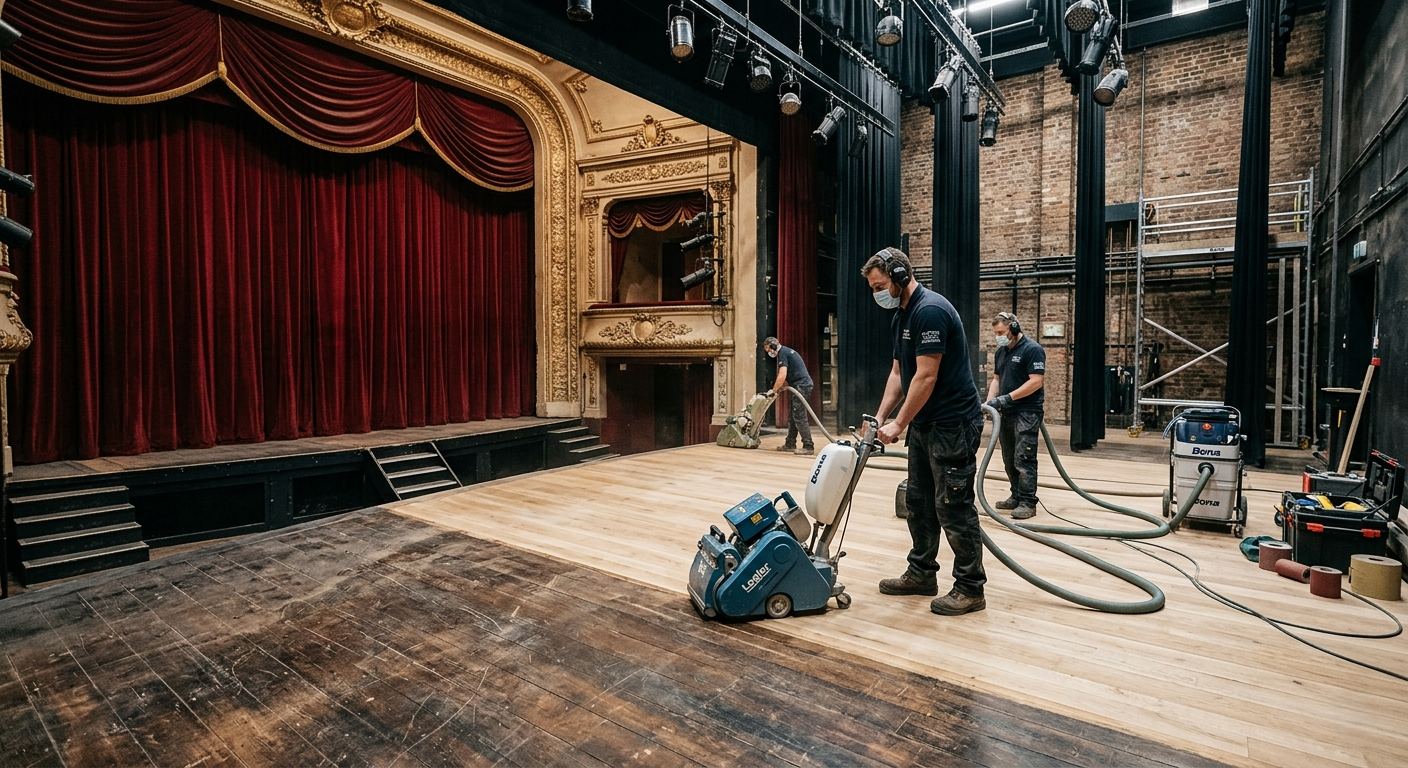
We utilize advanced, heavy-duty belt sanders equipped with integrated multi-stage extraction systems. This ensures an 99.9% dust-free environment, protecting delicate stage drapery, sensitive audio-visual equipment, and local air quality.
Our technicians sand through progressive grits—typically starting with a coarse grit to strip old, stubborn finishes and flatten imperfections, before finishing with a fine grit to open the timber grain for optimal seal adhesion.
4. High-Performance Commercial Finishing Options
A stage finish must balance exceptional durability with specific performance requirements. We offer a range of premium, professional-grade seals from industry-leading manufacturers:
Two-Component (2K) Polyurethane Lacquers: Brands like Bona and Loba offer specialized 2K lacquers that provide maximum scratch and scuff resistance. These are essential for stages handling heavy scenery tracking.
Slip-Resistant Finishes: We strictly apply finishes certified to commercial anti-slip standards (such as BS 7976-2), ensuring a safe surface for performers, dancers, and public access.
Hardwax Oils and Penetrating Oils: For heritage buildings and churches in conservation areas, products from Osmo preserve the natural, matte character of the timber while allowing it to breathe.
5. Aftercare and Commercial Wood Floor Maintenance Planning
Restoration is an investment that deserves protection. We provide tailored commercial wood floor maintenance in Notting Hill to extend the lifespan of your newly finished stage. This includes advising on appropriate pH-neutral cleaning solutions, protective padding for heavy equipment, and scheduling periodic mechanical screening and re-coating intervals to avoid the need for future full depth sanding.

Flexible Scheduling for W11 Institutions
We recognize that commercial operations cannot afford prolonged downtime. School stages are ideally restored during half-terms or the summer holiday window, while theatres and church halls require precise scheduling around performance dates and community use.
Our teams offer flexible, out-of-hours, and weekend working patterns to ensure your project is completed on time, within budget, and with minimal disruption to your daily operations.
Expert Commercial Floor Restoration
Choosing the right partner means selecting a specialist who balances technical precision with reliable project management.
Heritage Expertise: Over two decades of practical experience working on complex commercial and listed heritage properties across London.
Virtually Dust-Free Processing: Advanced extraction machinery ensures your premises remain clean, safe, and operational.
Transparent Quoting: We provide clear, fully itemized quotes based on site visits, precise measurements, or initial review of your photos and videos.
If you are evaluating the condition of a performance surface or organizing a broader program for commercial floor sanding in Notting Hill, reach out to our team for professional guidance.
Stage Floor Sanding in Notting Hill W11 – Frequently Asked Questions
Notting Hill W11 has several theatres, performance spaces and venues with stages used for plays, concerts, dance and events. These floors require careful restoration to maintain performance characteristics, safety and appearance. Professional stage floor sanding restores a durable, grippy and even surface with minimal disruption to productions and rehearsals.
Below are the questions we are most frequently asked about stage floor sanding in Notting Hill W11.
What is stage floor sanding?
Stage floor sanding is the professional process of sanding back worn wooden stage floors to remove old coatings, scratches and damage, then applying a new protective finish designed for performance use.
Why is professional floor sanding important for stages?
Worn or uneven stage floors can create safety risks for performers and affect movement, grip and acoustics. Sanding restores a safe, consistent and high-performance surface suitable for dance, theatre and live events.
Can you work around rehearsals, shows and events?
Yes. We regularly carry out stage floor sanding during dark weeks, between productions or overnight to minimise disruption to your schedule. We always plan the work around your performance calendar.
Do you work with sprung or semi-sprung stage floors?
Yes. We have extensive experience restoring both solid and sprung/semi-sprung wooden stage floors commonly found in theatres and performance venues.
How long does stage floor sanding usually take?
Most standard stages can be sanded and refinished in 3–6 days, depending on size and condition. We often work overnight or during quieter periods to reduce the impact on productions.
Is the sanding process dusty on stages?
We use professional dust-controlled sanding equipment with high-efficiency extraction. This keeps dust levels low, which is important for protecting costumes, props, lighting and sensitive stage equipment.
What finishes do you recommend for stage floors?
We use specialist performance finishes, including water-based lacquers from Bona and systems from Junckers. These provide the right balance of grip, durability and shock absorption for performers.
Can you repair damaged areas on stage floors?
Yes. We carry out targeted repairs to damaged boards, fill gaps and stabilise loose sections to create a safe and consistent playing surface.
Are the finishes suitable for different performance types (dance, theatre, etc.)?
Yes. We can tailor the finish to provide appropriate grip levels for various performance styles, including dance, acting and live music.
How often should stage floors be sanded?
This depends on usage. Busy performance venues often benefit from sanding every 4–7 years, with regular maintenance in between to keep floors performing well.
Do you use low-odour and quick-drying finishes?
Yes. We use modern low-VOC systems that allow venues to reopen within 24–48 hours after the final coat.
Can you work while other areas of the venue remain in use?
In many cases we can phase the work or carry it out overnight. We always aim to minimise disruption to ongoing activities and productions.
What maintenance do you recommend after sanding?
We provide clear aftercare guidance, including recommended cleaning products and routines suitable for performance environments. Good maintenance helps protect the floor between events.
Do you offer maintenance contracts for stage floors?
Yes. Many theatres and performance venues choose regular maintenance programmes to keep floors performing safely and reliably.
How much does stage floor sanding cost in Notting Hill W11?
Costs vary according to floor size, current condition, extent of repairs and finish requirements. We always provide transparent quotes after assessing your stage.
What makes stage floor sanding different from standard work?
Stage floors require specific performance characteristics such as grip, shock absorption and durability under impact. We focus on safety, functionality and minimal disruption to your productions.
How do I arrange floor sanding for my stage in Notting Hill W11?
Simply call us on 0800 335 7565 or send clear photos and videos of your stage floor. We can usually provide an initial assessment and quote quickly, with no obligation.
Why choose a specialist for stage floor sanding in Notting Hill?
Stage floors need finishes that support performer safety and movement while allowing quick turnaround between shows. Using an experienced team ensures the right preparation, suitable performance finishes and minimal disruption to your venue.

What you should do next
Contact our W11 office directly on 0800 335 7565 to arrange a site consultation, or email us your project dimensions and images for a prompt, expert assessment.


